
For nearly 60 years, conservatives have been trying to gut the Voting Rights Act of 1965, the crowning achievement of the civil rights movement. As a scholar of American voting rights. I believe their long game is finally bearing fruit.
The 2013 U.S. Supreme Court decision in Shelby County v. Holder seemed to be the death knell for the Voting Rights Act.
In that case, the court struck down a portion of the Voting Rights Act that supervised elections in areas with a history of disenfranchisement.
The Supreme Court is currently considering a case, Merrill v. Milligan, that might gut what remains of the act after Shelby.
Conservative legal strategists want the court to say that Alabama – where African Americans make up approximately one-quarter of the population, still live in concentrated and segregated communities and yet have only one majority-Black voting district out of seven state districts – should not consider race when drawing district boundaries.
These challenges to minority voting rights didn’t emerge overnight. The Shelby and Merrill cases are the culmination of a decadeslong conservative legal strategy designed to roll back the political gains of the civil rights movement itself.
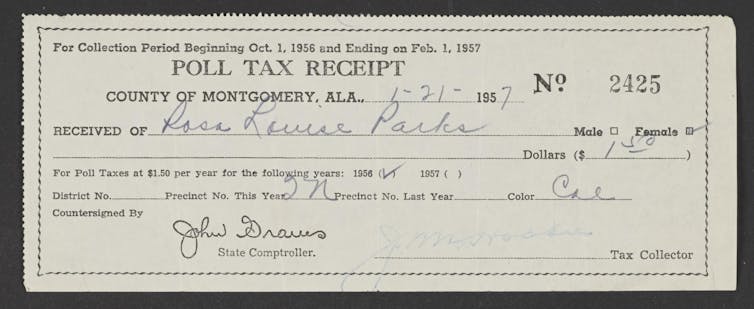
A number of Southern states had a poll tax that was aimed at preventing by Black people, many of whom couldn’t afford to pay it. This is a receipt for a $1.50 poll tax paid in 1957 by Rosa Parks. Library of Congress, Rosa Parks Papers
Victory – and more bigotry
The realization of civil and voting rights laws during the 1960s is often portrayed as a victory over racism. The rights revolution actually gave rise to more bigotry.
The Voting Rights Act criminalized the use of discriminatory tests and devices, including literacy tests and grandfather clauses that exempted white people from the same tests that stopped Black people from voting. It also required federal supervision of certain local Southern elections and barred these jurisdictions from making electoral changes without explicit approval from Washington.
These provisions worked.
After 1965, Black voters instigated a complexion revolution in Southern politics, as African Americans voted in record numbers and elected an unprecedented number of Black officials.
In fact, the VRA worked so well that it gave rise to another seismic political shift: White voters left the Democratic Party in record numbers.
As Washington protected Black voting rights, this emerging Republican majority capitalized on fears of an interracial democracy. Conservatives resolved to turn the South Republican by associating minority rights with white oppression.
In 1981, conservative political consultant and GOP strategist Lee Atwater recognized that Republicans might exploit these fears. He argued:
‘Retard civil rights enforcement’
It wasn’t just Southerners who aimed to undo the revolution enabled by the Voting Rights Act.
President Richard Nixon helped begin this process by promising Southerners that he wouldn’t enforce civil rights. In fact, in a secret meeting with segregationist Sen. Strom Thurmond, Nixon promised to ”retard civil rights enforcement.“
By the early 1980s, President Ronald Reagan also used white people’s growing fear of African American political clout to his advantage.
Reagan’s administration, according to voting rights expert Jesse Rhodes, used executive and congressional control to reorganize the Civil Rights Division of the Justice Department and the Supreme Court.
The objective?
To undermine how Washington enforced the Voting Rights Act – without appearing explicitly racist.
One of the Reagan administration’s strategies was to associate minority voting rights with so-called reverse discrimination. They argued that laws privileging minorities discriminated against white voters.
Undoing progress
Here’s the background to that strategy:
The years following 1965 were characterized by the dilution of Black Southerners’ voting power. Realizing that they couldn’t keep African Americans from voting, Southerners and segregationists resolved to weaken votes once they’d been cast. They gerrymandered districts and used other means that would dilute minority voting power.
African Americans took the fight to the courts. In fact, nearly 50 cases involving vote dilution flooded the court system after 1965.
Over the course of the 1970s, the Supreme Court met the challenge of vote dilution by mandating the implementation of majority-minority districts.
Conservatives during the early 1980s had become increasingly alarmed by the Supreme Court’s and Department of Justice’s preference for drawing racial district boundaries to give minorities more influence in elections in such ”majority-minority districts.“ These districts aimed to guarantee that minorities could elect candidates of their choice free from machinations such as vote dilution.
With little regard for vote dilution itself, conservative politicians and their strategists argued that majority-minority districts discriminated against whites because they privileged, like affirmative action policies, equality of outcomes in elections rather than equal opportunity to participate.
Tidal wave
This strategy paid off.
During the 1980s, Republicans used congressional control, a Republican White House and judicial appointments to turn the federal court system and the Department of Justice even further right.
By the 1990s, conservatives replaced federal officials who might protect the Voting Rights Act. In time, these developments, and growing conservatism within the courts, prompted conservative litigation that continues to shape civil rights laws.
A tidal wave of anti-civil rights litigation, led by a well-funded man, Edward Blum, flooded the court system. Blum sought to undermine the Voting Rights Act’s supervision of local elections and undo racial quotas in higher education and employment.
Blum, a legal strategist affiliated with the conservative American Enterprise Institute, helped engineer these now-famous test cases – Bush v. Vera (1996), Fisher v. University of Texas (2013) and Shelby v. Holder (2015). He also orchestrated two pending cases at the court that could reshape the consideration of race in college admissions, Students for Fair Admissions Inc. v. President & Fellows of Harvard College and Students for Fair Admissions Inc. v. University of North Carolina.
These cases, at their core, attacked the rights revolution of the 1960s – or rights that privilege minorities. The argument?
These protections are obsolete because Jim Crow segregation, especially its overt violence and sanctioned segregation, is dead.
New claim, old game
Nearly 30 years of Republican or divided control of Congress and, to a lesser degree, the executive office gave rise to increasingly conservative Supreme Court nominations that have not just turned the court red; they all but ensured favorable outcomes for conservative litigation.
These include the Shelby and Merrill cases and, more recently, litigation that seeks to remove racial considerations from college admissions.
In the Shelby case, the court held that the unprecedented number of African Americans in Alabama – and national – politics meant not merely that racism was gone, it meant that the Voting Rights Act is no longer relevant.
These cases, however, have all but ignored the uptick in conservatives’ claims of voter fraud and political machinations at polling stations in predominantly minority voting districts.
In fact, the rise of voter fraud allegations and contested election results is a new iteration of old, and ostensibly less violent, racism.
The Voting Rights Act was not only effective; Washington was also, initially, committed to its implementation. The political will to maintain minority voting rights has struggled to keep pace with the continuity of racist trends in American politics.
The work of protecting minority voting rights remains unfinished.